
Mushrooms are Marxist (sort of)


Have you ever had the honour of looking at a fungal species and casually going, "Oh, look at the very uncanny, absolutely indubitable, resemblance this innocent piece of a (perhaps dead) saprophytic organism has to one of the world's most hotly debated socio-political systems"?

No?

Well, now you will.

What is Marxism?

In an alternate timeline, the world is run by socks. There are two ways in which this can work out.

A problem that could even challenge Sock-rates


Plan A

Firstly, some people start with a lot of socks, and they can buy and sell socks freely. The more socks they have, the more power and influence they hold. This leads to a sock hierarchy, where some people have sock abundance, while others struggle to get even a single pair. 

The sock market is competitive, and folks are driven by the desire to accumulate as many socks as possible. 

What this also means is the market-driven sock society promotes individualism, choice, and the pursuit of the comfiest and most stylish socks.

From a purely economic point of view, it's a system where individual success is the primary focus.

Welcome to capitalism, mi amigo.

Everybody has a different amount of socks, and this determines their social standing


Plan B

Second system. Here we go.

Here, there's a Universal Sock Sharing Coalition. Folks work together to produce socks collectively, and everyone gets an equal share of the socks. The idea is to eliminate the sock inequality seen in the capitalist part of the world. 

There are no rich sock-owning people or poor sock-less people; instead, everyone contributes to sock production, and socks are distributed according to everyone's needs. 

The emphasis is on cooperation and the common good, with the goal of achieving a classless sock society.

However, this approach means that there's less variety in sock styles, as the focus is on meeting essential needs rather than catering to individual preferences.

This, right here, is an intensely watered-down version of Marxism.

"Pretty cool, huh." - Not the first person


So in the end, it boils down to the argument between competition and cooperation. What is more important? Individual success or collective well-being?

Some people prefer not to take a side at all. These fellows sometimes call themselves centrists and derive great joy from pissing off both sides, as in, marxists and capitalists, by pointing out their mistakes.

Others don't get involved in side-taking at all – these people are called apolitical. Is it an open-minded approach or a rather cowardly one? You decide.


What is a Mushroom?

A mushroom is the fleshy, spore-bearing fruiting body of a fungus, typically produced above ground on soil or on its food source.
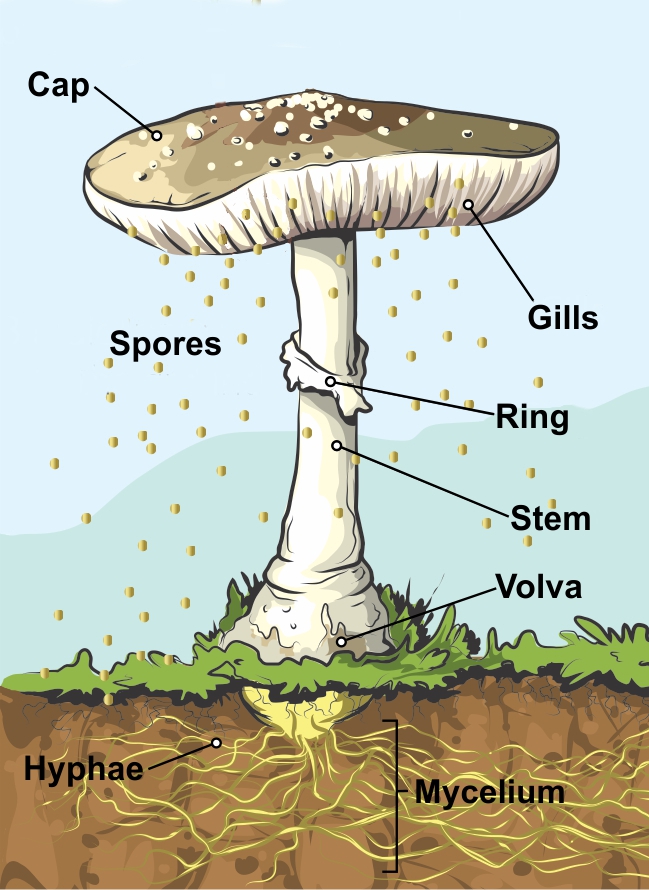


Mushrooms play various ecological roles, such as decomposing organic matter, forming symbiotic relationships with plants, and serving as a food source for animals and humans. 

Some mushrooms are edible and used in culinary dishes, while others can be toxic or hallucinogenic. 

The study of mushrooms is known as mycology, and these fungi are a diverse group with an extensive range of shapes, sizes, and ecological functions.


Why are Mushrooms Marxists?

Well, they're not.

I think you've noticed that mushrooms aren't exactly very conscious of themselves, let alone of the governing bodies that might potentially rule over them.

But we've come this far. Let's try anyway.


Networked Structures

The mycelium, an intricate network of fungal threads, establishes a symbiotic connection between different organisms. Likewise, Marxism highlights the interdependence of individuals within a society. The mycelial network can be interpreted as a symbol for the collective bonds envisioned in Marxist ideology, where individuals collaborate for the betterment of all.
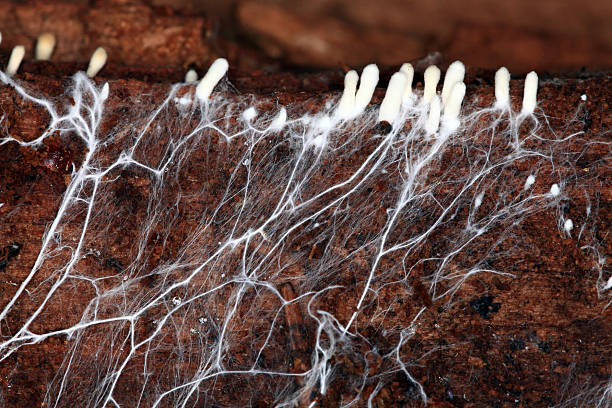
Peekaboo! I see you!


Communal Living and Cooperation

Mushrooms often grow in clusters and depend on the surrounding environment for nutrients. Similarly, Marxism advocates for a society where resources are shared collectively, emphasizing cooperation over competition. The communal growth of mushrooms mirrors the collective ideals of Marxist theory.


Decomposition and Redistribution

Fungi, particularly decomposer fungi, play a crucial role in breaking down organic matter and redistributing nutrients in the ecosystem. Marxism, in its critique of capitalism, calls for the redistribution of wealth and resources for a more equitable society. Both fungi and Marxism involve processes of breaking down existing structures for a more balanced and sustainable outcome.

Most fungi are saprophytic, as in, they derive nutrition from dead and decaying organic matter

Adaptability and Evolution

Fungi are known for their adaptability to different environments and changing conditions. Marxism, as a socio-political theory, encourages adaptation and evolution of societal structures to address the needs of the people. Both fungi and Marxism highlight the importance of adaptability for survival and progress.


Natural Hierarchies

Mycelium operates without a clear hierarchy, with each part contributing to the well-being of the whole. Marxism challenges traditional hierarchical structures in society, advocating for a more egalitarian distribution of power and resources. The decentralized nature of mycelium can be seen as a metaphor for the decentralization advocated by Marxist ideals.


And there you go. Mushrooms are now Marxists. Nobody will ever dare doubt it again. Right? Right?


Examinations shall forever remain a tumultuous period in the life of most human beings, and while I might seem like a distant internet persona hiding behind a Tintin profile picture and occasional bouts of dark humour and societal critique, it would be of great interest to the reader to know that I do, in fact, also have exams - and I do, in fact, try to prepare for some of them. 

But I have a few posts in the drafts now, some of which I am fairly proud of. I can't wait to get them published, and finishing touches are on!

Thanks for sticking around, and your patience is much appreciated and envied!

Also - a little food (no mushroom was harmed in the making of this dish) for thought. Which organism would you choose to classify as capitalist?

-BracketRocket

Comments

  1. https://www.dragonherbs.com//media/wysiwyg/pdp-clp/banner-mushroom3.jpg

    ReplyDelete
    Replies
    1. i feel as if le banan is a capitalist. no reason apart from ~vibes~
      stunning and educational article as always :))) <3

      Delete
    2. Arguably one of the best jumpscares on the internet. 🏆

      "i feel as if le banan is a capitalist."
      Definitely agree, although I can't think of why. Squirrels feel like the group of people who pretend to be socialist, but are hardcore capitalists in the depths of their souls.

      Delete
  2. surely the christmas fig is capitalist

    ReplyDelete
    Replies
    1. Oh definitely. Most things related to festivities can be called capitalist, in one way or the other.

      Delete

Post a Comment

Popular posts from this blog

The History of Time Travel

The Time Machine (1960) If my affinity for limericks is a secret, it is a terribly kept one. I have even published one of my own (albeit of questionable quality), about monkeys and typewriters , on this very blog. One of my favourite limericks would almost certainly be There was a young lady of Wight, Who travelled much faster than light, She departed one day, In a relative way, And arrived on the previous night.  I have no clue as to who the original author is, only a vague recollection of discovery in a Stephen Hawking book.  In picture: Young lady of Wight There is nothing that science fiction loves more than stretching the commonplace observations of the world around us, if only to test the strengths of believability. It does this with space (as seen in teleportation, which I've already rambled about  in the first post on this blog!). In classic Einstein fashion, we move on the the other aspect - time. Time travel has been a popular aspect of science fiction since the...

Thomas Edison and the Cyclicity of Pulp

The only thing more fascinating than pulp fiction is the contemporary commentary – condemnation? – of whatever genre it exemplifies at a given period of time, and the subsequent pedestal-perching of said genre by posterity. For this, of course, I use a more expansive definition of ‘pulp fiction’ than is generally recommended. Pulp fiction (as generally recommended) refers to stories published in pulp magazines, which were cheap, long-running fiction series printed on rough wood-pulp paper. ‘ Generally recommended ’ The pulp fiction I refer to is more all-encompassing: anything popular, cheap, aimed at a younger audience and ‘sensationalist’. (The last descriptor I dislike as an adjective for fiction; I believe it ought to restrict itself to journalism, where its services are necessary and its application plentiful, but I digress.) A better term might be contemporary fiction, but that flowery ornateness doesn’t quite capture the plosive gun-shotty decadence of good-for-nothing kids-the...

Shakespeare and Subjectivity (or the lack thereof)

  “The tartness of his face sours ripe grapes.” The Comedy of Errors (Act 5, Scene 4) Shakespeare is no saint. All of his plays have a little something against our "modern values", and honestly, it's irrational to be surprised.  The "Bard of Avon", inventor of most of modern vocabulary, lived from 1564 to 1616. Society four hundred years ago upheld different beliefs and ideals, some which we have retained today, but even more that we 'pooh-pooh' or find straight-up offensive. Elizabethan theatre was...quite a big deal Fiction is a reflection of fact, and fact is a reflection of fiction. When we bring up various issues in Shakespeare's works, are we critiquing the playwright, or the society he was lived in? Case in point: Merchant of Venice. Rampant antisemitism against Shylock the Jewish moneylender. When his daughter elopes and converts to Christianity, it is shown as a positive outcome and an ideal "happy ending".  Portia, the oh-so-smar...

Tackling Absurdism

You are a complex and nuanced individual. You have layers to your personality. You meet multiple people daily, you have so many experiences. You have a story to tell, your interests, aspirations, hopes and dreams.  You may sometimes feel like you're the most complicated being on earth. After all, you have so much going on, don't you? But so does everyone else. Everybody else has their own stories, problems, dreams. Everyone else thinks they're a complex person. And that's because they are. We live in a complex world, after all. All this, for what? What even are we, a swarming bunch of self-righteous, self-absorbed microbes on a rock in the middle of nowhere? What is the meaning of life? What's the point anyway? Every single action that happened since the beginning of the universe, right from the big bang, every slightest choice has led up to this - upto your reading this blogpost. The smallest difference would have changed this outcome vastly. Our present is a mosai...

Alien Communication: A Micro-Rant

 The Drake equation is a (shock horror!) equation that allows one to calculate the probability of aliens in the Milky Way. It was formulated, not by Sir Francis Drake of late sixteenth-century world-circumnavigation fame, but by American astrophysicist and astrobiologist, Frank Donald Drake, in 1961.  According to it, Number of civilisations in the Milky Way with whom communication is possible       =           Rate of star formation in Milky Way           ×      Fraction of stars with planets           ×      Avg number of planets capable of supported life per star-with-planet           ×      Fraction of planets capable of life that actually develop life           ×      Fraction of planets with life that develop intelligent life i.e., civili...

The History of Teleportation

T eleportation is an essential element of pop sci-fi, simply because we can all agree that waiting for our protagonist to travel for centuries across galaxies to fight the final battle would be quite a drag. Today, this fantastic form of transport is found amply, especially in video games, where they are often referred to as “Warps.”  Wormholes are also picked as a convenient way for the bedazzling protagonist, but that’s a story for another day. The roots of teleportation, at least as it was first introduced to mankind, lies in the fantastical realm of imagination. Imagination! Tachypomp, and other books The first written mention of our hero can be found in a 1874 book, ‘Tachypomp’ where the titular device makes matter travel at an infinite speed. In 1877, The Sun published a short story from this very book called, The Man Without a Body, in which Edward Page Mitchell writes about ‘matter transfer’. A man apparently discovers how to rearrange the atoms of his cat’s body and send ...

Running out of Turing Tests

In his laconically named 1637 treatise,  Discourse on the Method of Rightly Conducting One's Reason and of Seeking Truth in the Sciences , René Descartes argued that while a mechanical body could imitate human behaviour if it so wished, true thought (therefore true being) was exclusive to the res cogitans –  the thinking substance – which machines could never possess.  One wonders if this was taken as a challenge, and (separately) if it was meant to be one. In the centuries to follow, mechanistic fantasies could only further proliferate the living world. Jacques de Vaucanson's grain-kernel-digesting-and-excreting duck from 1764, for instance – deft as it was in its intended simulation – marked the beginning of the hunt for the line between imitation and genuine cognition.  An American artist's (incorrect) explanation for how the duck managed to eat and excrete grain. On inspection some half century down the line, a French illusionist concluded the it did not, as...

Venus in Fiction

  O ver the years, our understanding of the universe has changed drastically with every scientific breakthrough paving the path to a clearer picture.  Even today, there is much left to be known about our cosmos.  But that’s of no consequence to our illustrious poets, writers and artists. They have the creative freedom to imagine a world which defies the laws of physics and can weave countless stories around it, turning it into a legend. Venus is one such world. Venusian Knowledge Today Today, any six-year-old would be only too happy to regale you with their knowledge of earth’s twin sister.  Venus is the second planet from sun, they would tell you, with an all-knowing smirk, and it’s the hottest planet in the solar system, with a thick atmosphere full of carbon dioxide.  Oh, and don’t you try to visit it, they add, warningly. It’s very unsuitable for life. Why does the six-year-old know so much? It’s because space agencies from around the globe have contributed ...

The Legendary Solar Eclipse

 8th April, 2024. Not an ordinary day. It is the date of the full solar eclipse, that will pass over regions of North America. The sky will darken (I sound like a Nostradamus rip-off with an Internet connection, but bear with me), akin to dusk or dawn, and if one is lucky enough to have clear skies, the corona (outer atmosphere of the sun) should be visible in an awe-inspiring ring around the shadow of the moon.  Truly a sight to behold Of course, not all visible things are meant to be seen. Not with naked eyes anyway. If you happen to be within the range of this celestial event, by all means, enjoy it - but with the necessary safety precautions in place. Looking at the sun in such a state (or otherwise, actually) directly, or through a telescope/camera/binocular lens is bound to cause severe, and oftentimes untreatable, eye injury.  You have an excellent brain. Use it. Implement indirect means of viewing. Look at it through a pinhole camera, or safe solar viewing glasses...

2001: A Movie Review

This is from 1968? And I'm expected to believe that?   July 20th, 1969. A truly astronomical feat of humankind. Neil Armstrong and Buzz Aldrin became the first people on the moon, as millions of folks watched, absolutely enraptured, from their TVs sets here on good ol' Earth.  And, like most historic monuments in our scattered timeline of existence, popped up the omnipresent scatterbrains - the conspiracy theorists. Because, well, why shouldn't they? There's always an xkcd for that As I was doom scrolling through the Wikipedia article concerning itself with this delightful topic, one thing stuck out to me - a name .  There was one singular  name on the entire blasted index box.  The name was Stanley Kubrick.  It was fuzzily familiar, and a few quick clicks revealed why. The poor fellow had had the misfortune of directing a "cinematic masterpiece", a true trailblazer who walked so every other space movie could run - Stanley Kubrick was the director of 2001: ...