
Teleportation is an essential element of pop sci-fi, simply because we can all agree that waiting for our protagonist to travel for centuries across galaxies to fight the final battle would be quite a drag. Today, this fantastic form of transport is found amply, especially in video games, where they are often referred to as “Warps.”
Wormholes are also picked as a convenient way for the bedazzling protagonist, but that’s a story for another day. The roots of teleportation, at least as it was first introduced to mankind, lies in the fantastical realm of imagination.
 |
| Imagination! |
Tachypomp, and other books
The first written mention of our hero can be found in a 1874 book, ‘Tachypomp’ where the titular device makes matter travel at an infinite speed. In 1877, The Sun published a short story from this very book called, The Man Without a Body, in which Edward Page Mitchell writes about ‘matter transfer’. A man apparently discovers how to rearrange the atoms of his cat’s body and send it across telegraph. He tries it on himself, but the telegraph runs of battery mid-way, having his head transported but the rest of the body intact.
There’s a 1957 British horror film of the same name, which promises to
be the “Most Incredible Screen Shock You Have Ever Gasped At!”, although the
plot is turned on its head. A businessman with brain tumor convinces a
scientist experimenting with monkey heads to transplant the head of Nostradamus
on him.
A generous review on the film insists that ‘Even Nostradamus could not
have predicted this mess’. So, watch it at your own risk.
But I digress.
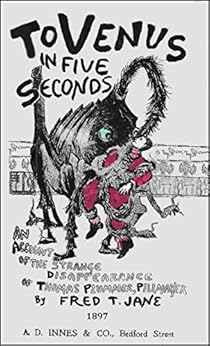
When we think of teleportation, interplanetary space travel is a staple. This concept was introduced for the first time in the 1897 science fiction parody novel, To Venus in Five Seconds: An Account of the Strange Disappearance of Thomas Plummer, Pillmaker, written by Fred T. Jane.
But it’s not just obscure pieces of literature which are concerned with teleportation. Not everything requires written evidence. For instance, teleportation has been explored in the realm of magic as well. And no – I’m not talking about Harry Potter. I mean the sort of magic seen on stages, televisions, parties and fairs.

Interestingly, this trick has been well known since
3 B.C., and was quite popular among Roman conjurers. One can find it mentioned
in their texts:
Fort’s Ideas
The word “Teleportation” itself was coined by an American writer and researcher, called Charles Fort, who’s quite a personality himself. He was a pioneer in the field of Anomalistics (which is sometimes classed as pseudoscience), the use of scientific logic to evaluate phenomena currently outside of our understanding. Sub-disciplines include cryptozoology, parapsychology and of course, ufology.

Fort spent most of his time collecting data published
in journals and magazines about inexplicable phenomena, which he called ‘Damned
Data’. He published a collection in 1919, called ‘The Book of the Damned’. He received
some fan following and it lead to the creating of the ‘Fortean Society’. Fort
published four books in his lifetime. The third one, called Lo! Discusses teleportation.
But I digress.
When we think of teleportation, interplanetary space travel is a staple. This concept was introduced for the first time in the 1897 science fiction parody novel, To Venus in Five Seconds: An Account of the Strange Disappearance of Thomas Plummer, Pillmaker, written by Fred T. Jane.
Jane
himself was a scholar on warships and aircrafts, his Magnum Opuses in this
field being “All the World’s Fighting Ships” and “All the World’s Airships”. The
Jane’s Information Group, which publishes an annual reference book of all the
world’s warships till today, is named after him. He also illustrated a number
of novels, including his own, ‘To Venus in Five Seconds’. The book itself was
intended to poke fun at the popular elements of science fiction, or, as it was
then called, scientific romance.
In short, the plot revolves around a young man named Thomas
Plummer. Plummer goes to tea with a young woman named Miss Zumeena, whose house
(a gazebo) is mysteriously full of machinery. Mid-meal, Miss Zumeena informs
Plummer that they have been transported by the machinery to Venus.
Jane doesn’t
provide any further explanation, except a bit about ancient aliens from Venus hiding
their inventions in Egypt and Mexico. This vague description outshines its
competitor by a light year – Edgar Rice Burrough (incidentally the inventor of Tarzan)
intended on reaching Mars by simply wishing for it.
Magic!
But it’s not just obscure pieces of literature which are concerned with teleportation. Not everything requires written evidence. For instance, teleportation has been explored in the realm of magic as well. And no – I’m not talking about Harry Potter. I mean the sort of magic seen on stages, televisions, parties and fairs.
The most common application can be seen in the
cup and ball routine. It includes a number of cups, usually three or more. A ball
(or balls, as the case may be) is kept under one of the cups. The cups are
swiveled around and the audience needs to guess which one the ball is under. A
diligent audience watches the movements closely and picks the cup. But hey
presto! The ball has disappeared, and is discovered hiding under another cup.
There a number of variations of the trick, and it’s arguably one of the most
well-known magic tricks not involving cards.
Such quibbles are just as harmlessly deceptive as the juggler's cup and dice, in which it is the very trickery that pleases me. But show me how the trick is done, and I have lost my interest therein.
Fort’s Ideas
The word “Teleportation” itself was coined by an American writer and researcher, called Charles Fort, who’s quite a personality himself. He was a pioneer in the field of Anomalistics (which is sometimes classed as pseudoscience), the use of scientific logic to evaluate phenomena currently outside of our understanding. Sub-disciplines include cryptozoology, parapsychology and of course, ufology.
It is perhaps one of the first books to use teleportation as a serious
explanation for real life events and not simply as a fictional plot device. He
reviews the cases of Mary Celeste and Agatha Christie, among others, as
evidence. According to him, people may be mysteriously transported from one place
to another by accidental teleportation, the side effect of which is chiefly
amnesia.
Clearly, humanity has been obsessed over this perceived superpower since the very beginning. How far will this obsession take us in the future?
Only time will tell!
- BracketRocket
Comments
Post a Comment