8th April, 2024. Not an ordinary day. It is the date of the full solar eclipse, that will pass over regions of North America. The sky will darken (I sound like a Nostradamus rip-off with an Internet connection, but bear with me), akin to dusk or dawn, and if one is lucky enough to have clear skies, the corona (outer atmosphere of the sun) should be visible in an awe-inspiring ring around the shadow of the moon.
 |
| Truly a sight to behold |
Of course, not all visible things are meant to be seen. Not with naked eyes anyway.
If you happen to be within the range of this celestial event, by all means, enjoy it - but with the necessary safety precautions in place. Looking at the sun in such a state (or otherwise, actually) directly, or through a telescope/camera/binocular lens is bound to cause severe, and oftentimes untreatable, eye injury.
You have an excellent brain. Use it. Implement indirect means of viewing. Look at it through a pinhole camera, or safe solar viewing glasses, commonly known as eclipse glasses. Have fun, be safe.
 |
| A newspaper from 1970 reporting the next eclipse |
The prediction of eclipses (solar and lunar alike), is not a modern phenomena. Astronomy is one of the oldest sciences to exist, which is fairly justifiable, especially from a practical perspective.
So many cultures have their roots in agriculture (get it? roots?). The essence of agriculture is time-management. Figuring out when the crops are to be sown and reaped was (and still is) a question of survival and oblivion.
The logical step to solidify this surety of time was calendar-building. And what's a better indication than the skies above? The movement of constellations and planets was enough to tell them about the seasons. And seasons helped them with crops.
However, the ancients were given to the same follies as you and I. Perhaps it is a universal human flaw. I cannot tell for sure, because I haven't met every human ever (there is not remorse behind this sentiment). Everybody loves a good rabbit hole.
And astronomy makes for an excellent rabbit hole.
As methods became more and more sophisticated, precise and useful, they gained the capacity to predict the otherworldly phenomena that are eclipses.
 |
| It's a great place to let your imagination loose! |
"Ha!" cried our ancient astronomer, looking around triumphantly at the little scrolls of whatever writing material they used in their time - parchment, leaves, stretched animal skin. "I know the when. But what of the why?"
They leapt to their feet and scrambled around the piles and piles of documents. The events they had been hacking away at tirelessly. The why. The why. No answer.
"It is eerie," they muttered, "It is strange. Surely it is not of this world. Why should the sun hide himself from us? What is the thing that hides the him? Is he sick? Is he being hunted? Surely there is a story."
(It is to be noted that the ability to predict an event doesn't equate to understanding it.)
And a story there is. And if there isn't, they're resourceful enough to make up one.
The various ancient cultures of the world have overflowing treasure troves of legends and mythology related to this mind-numbing event.
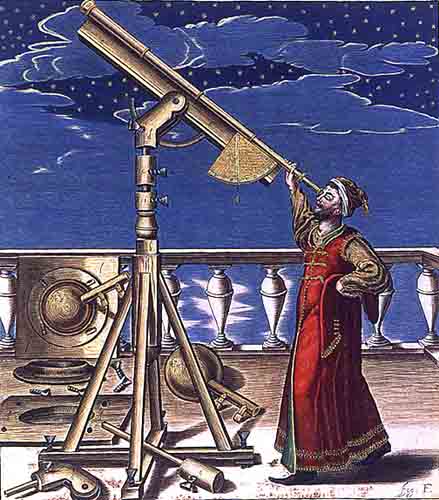
The world 'eclipse' comes from the Greek word for 'abandonment'. The ancient Greeks decided that eclipses were a way for gods to express their displeasure at the puny irritating beings that humans are, and used it as a threat. They believed the sun would abandon the earth and bring 'untold misery' (which is a phrase so delicately spine-chilling, that their reaction is quite understandable).
 |
| I don't know what untold misery is, and I don't want to find out. |
The Incas worshipped Inti, the all-powerful Sun God. Inti was usually quite benevolent, but sometimes things got out of hand and he was forced to show his wrath in the form of solar eclipse. Transylvanian folklore had a similar idea. An angry sun turns away and covers herself in a black cloth.
Human are annoying, aren't they?
Not all suns are frustrated. Sometimes, they're running away. From the moon.
According to the Euahlayi people from southeast Australia, the Sun is a woman named Yhi, while the moon is a man named Bahloo. Yhi's love for Bahloo leads her to chase him across the sky. Yhi warns the sky spirits that if they allow Bahloo to escape, she will bring darkness upon the world (resulting in a total solar eclipse). To counter this threat, a medicine man would recite powerful chants.
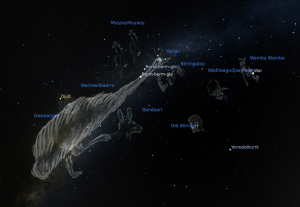 |
| The emu in the sky, as seen by the Euahlayi people. |
The Inuit tell of the Sun goddess Malina, who is chased across the sky by her brother, the moon god Igaluk. Occasionally he catches up with her for a brief reunion and everything goes dark. It's all but a game of catch-me-if-you-can.
In other cultures, the sun is faced with mortal peril.
The sun is almost devoured by a whole host of beings including but not limited to a puma (Andean mythology), a black squirrel (Choctaw legend), and a celestial dragon (Chinese myth).
In the US Northwest, the Pomo people have an intriguing name for solar eclipses - "The Sun got bit by a Bear". According to their folklore, a bear (*wink wink*) takes a leisurely walk along the Milky Way and bumps into the Sun. The bear and the sun have an argument as to who should give way to the other. This disagreement escalates into a full-blown fight, resulting in the eclipse.
In Norse culture, the trickster Loki gets chained by the gods. He attempts revenge by sending out two wolf-like creatures to chase the sun and moon respectively, Sköll and her brother Hati. Solar eclipses signal the temporary victory of Sköll.
.jpg.webp?itok=3TswALab) |
| There goes Sköll! |
Hindu mythology tells the story of Swarbhanu, the snake demon who outwitted the gods to drink 'Amrit', the drink of immortality. The moon and the sun conspired to tell the gods, who chopped his head off, but he remained alive, split in two parts - Rahu and Ketu. Rahu and Ketu became sworn enemies of the moon and the sun, and periodically swallow them, resulting in lunar and solar eclipses.
And then, of course, my personal favourite. The Bella Coola people of Canada figured that the Sun was just a little clumsy and occasionally dropped its torch.
Oh well.
Happens to the best of us.
I too hate when I drop my torch and something hides the me
ReplyDeletefun fact! there’s also a chinese myth about a celestial dog eating the sun/moon 😋
mmmm yummy sun :)
DeleteOh, so does the dog eat the moon during lunar eclipses as well? That's interesting.
Deletethe sun deserved it. bear is superior
ReplyDeletehttps://images.ctfassets.net/pujs1b1v0165/3zi8YuHlYFL5x9DxGhII3C/3c1b44fbda89b6ec14c1be61248f9822/how_fast_can_bears_run_.jpg?w=1280
Delete